
Why a year-round calendar beats four disconnected buys
Most buyers approach seasonal flowers as four separate purchases. Spring is ordered when spring stock runs low, autumn is ordered when the summer sell-through numbers come in, and Christmas is ordered under pressure in the busiest month of the year. Each buy is rational on its own, and the collection as a whole ends up incoherent: palettes that do not sit together, price points that jump between seasons, and leftover spring inventory competing with new autumn stock for the same shelf space.
The alternative is to plan the year as one assortment with four movements. That shift changes what you order, how far ahead you commit, and how you exit each season. It also tends to raise full-price sell-through, because the arrival of new seasonal stock is a merchandising event rather than an interruption.
The four buying windows and what belongs in each
Sales peaks are fixed by the calendar, but production slots are booked months earlier. Working back from the peak gives you the four windows below. Treat the "commit by" column as the deadline for placing the production order, not the deadline for deciding what you want.
| Window | Season it serves | Commit by | Core assortment |
|---|---|---|---|
| Late winter | Spring and early summer | 3–4 months before peak | Light bouquets, pastel stems, fresh-green vines and ferns |
| Late spring | Summer and outdoor living | 3 months before peak | Lean foliage, bright accent sprays, low-maintenance container pieces |
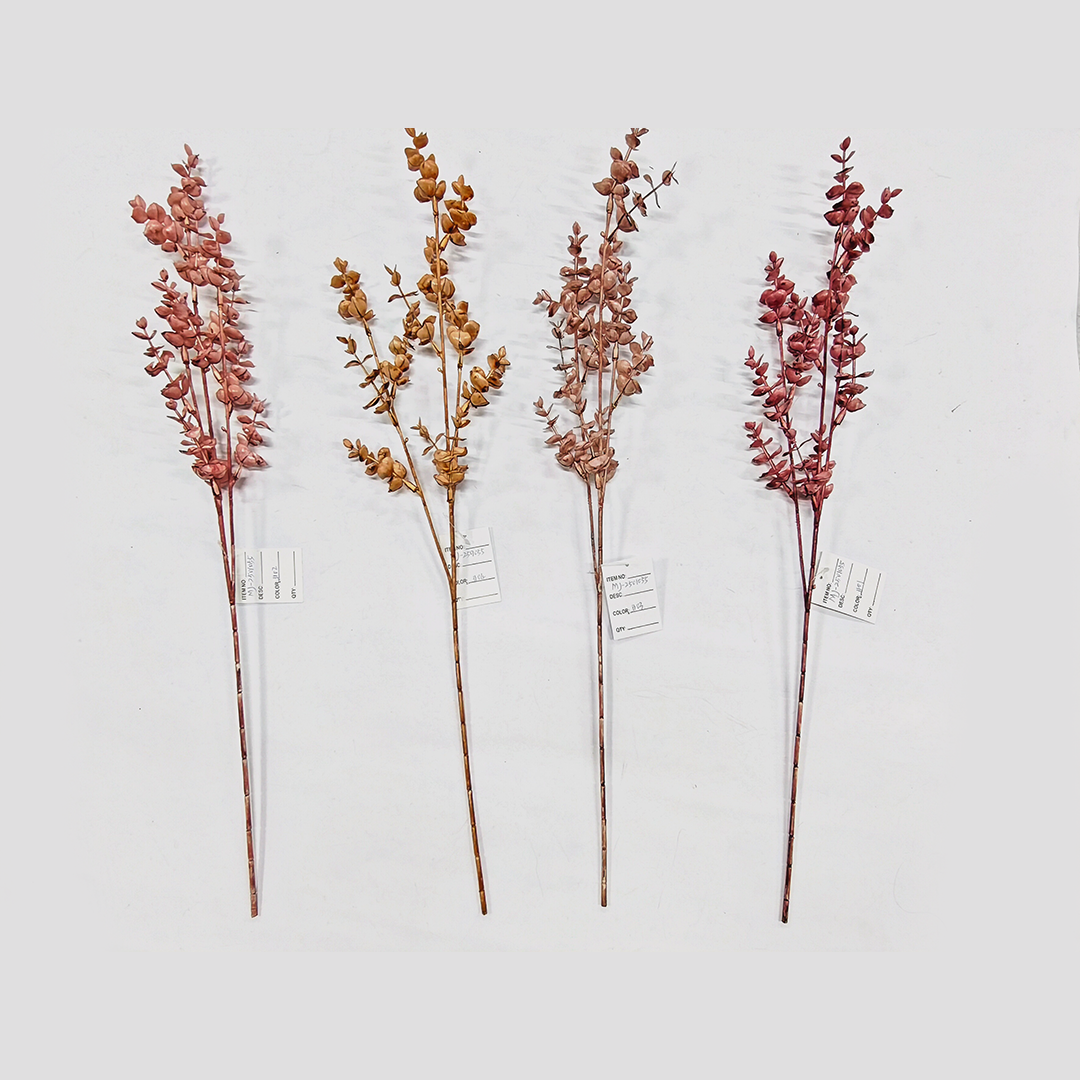
| Midsummer | Autumn and harvest | 3–4 months before peak | Warm-tone grasses, berry sprays, muted eucalyptus, wheat-type stems |
| Late summer | Christmas and holiday | 4–5 months before peak | Wreaths, garlands, poinsettia-type focal pieces, red and deep-green accents |
Two patterns are worth noting. First, the holiday window is the longest lead because it is the largest volume and the most contested production capacity of the year. Second, the gap between autumn and Christmas is short — if you order autumn and holiday in the same month, you will be making decisions about the holiday assortment before you have any autumn sell-through data to guide them.
How far ahead to commit, and why earlier is not always better
There is a real tension here, and it is worth stating plainly.
- Committing early secures production capacity and the best freight rates, and it locks in material costs before any seasonal price movement. The risk is that you commit to a color or a silhouette before you have seen how the market is moving.
- Committing late gives you better information, but capacity at that point is whatever is left, freight is more expensive, and the only available slots are usually late in the production run — which is exactly when schedule slippage hurts most.
The practical resolution is to split each seasonal buy. Commit a core volume early, covering the shapes and palettes you are confident about, and hold a smaller open quantity for a later fill-in order once you have early-season signals. This is the same approach apparel buyers use, and it works for the same reason: the core carries the season, and the fill-in order captures the upside.
The evergreen core
Roughly half of a well-built assortment should not be seasonal at all. This is the evergreen core: neutral bouquets, standard greenery, vase-ready arrangements in white, cream and green, and the container pieces that sell twelve months a year.
The evergreen core does three jobs. It keeps the shelf full between seasonal peaks. It absorbs the cost of the seasonal buy by sharing container space and freight. And it gives you a stable base of SKUs whose performance you can measure cleanly, season after season.
Color forecasting without over-betting
Every season arrives with a forecast palette, and following it too literally is one of the more expensive mistakes in seasonal buying. A forecast is useful in proportion to how much of your assortment you can afford to put behind it.
A workable rule is to let the forecast move the accents rather than the base. In practice:
- The base — the greens, the neutrals, the large-mass pieces — stays within a range that has sold for several seasons. These are your volume drivers and they should not be gambled on a single-season trend.
- The accent layer — the berry sprays, the secondary bloom colors, the ribbon and trim — carries the forecast. Accent volume is smaller, so a forecast that does not land costs less.
- The statement piece — one or two silhouettes per season — is where you take a genuine position on the forecast. Keep the quantity low and be prepared to exit it at full price or not at all.
This structure means a forecast that misses reduces your accent margin rather than stranding your core inventory.
Inventory transition: when to mark down and when to hold
The most common source of lost margin in a seasonal program is not buying the wrong thing. It is holding the right thing too long, or exiting the right thing too early.
Mark down when the product is date-linked
Christmas pieces, harvest-motif stems and anything whose color or iconography ties it to one specific window of the calendar should be cleared decisively at the end of that window. Carrying red-and-green pieces into January does not recover their value; it simply occupies space that spring stock needs.
Hold when the product is only color-linked
Warm-toned stems, muted foliage and neutral bouquets sit outside the holiday calendar entirely. These can be held through the seasonal turn with minimal risk, and holding them avoids the double loss of a markdown plus a replacement purchase. A copper-tone grass spray sells in September and still sells in February to a customer decorating a hallway.
Track a transition number, not a gut feeling
Set a target for the share of seasonal inventory you intend to carry into the next window — many buyers use ten to fifteen percent as a working ceiling. Review it at the same point in every season. A consistent number lets you see whether the problem is the buy or the exit.
A sample twelve-month planning view
| Period | What is selling | What you are doing |
|---|---|---|
| Jan–Feb | Evergreen core, light spring previews | Exiting holiday stock; receiving spring |
| Mar–Apr | Spring bouquets, pastel stems, fresh greens | Spring at full price; measuring sell-through |
| May–Jun | Evergreen core, outdoor and container pieces | Placing autumn production order |
| Jul–Aug | Evergreen core, early autumn previews | Exiting spring remnants; receiving autumn |
| Sep–Oct | Autumn grasses, berry sprays, warm foliage | Autumn at full price; placing holiday fill-in |
| Nov–Dec | Wreaths, garlands, holiday focal pieces | Peak trading; final holiday receipts |
Read the table diagonally and the logic becomes clear: while one season is selling, the next season is being committed. That overlap is what makes a year-round program work, and it is what a series of reactive buys cannot replicate.
Frequently asked questions
Q: How many SKUs should a seasonal program carry?
A: Start from the shelf or page space you actually control, then allocate roughly half to the evergreen core and half across the four seasonal windows. A larger range than the space can present professionally usually sells less, not more.
Q: Is it better to develop new seasonal designs or re-color proven ones?
A: Re-coloring a proven silhouette is the lower-risk route and it is what most effective programs do for the bulk of the range. Reserve genuinely new designs for the statement layer, where the potential upside justifies the tooling and sampling cost.
Q: How do I handle markets with different seasonal calendars?
A: Group your markets by hemisphere and by holiday pattern rather than treating the calendar as global. Warm-climate markets often want lighter foliage and a shorter holiday window, so the assortment mix shifts even when the timing barely does.
Q: What is the biggest avoidable cost in a seasonal program?
A: Air freight on late fills. Almost every air-freight emergency traces back to a holiday order placed after the production window closed. Committing the core volume early is the cheapest insurance available.
Plan the year, then order the season
Send us the seasons you trade into, the shelf or page space you work with and your target price points. We will help you lay out an evergreen core plus four seasonal movements, match it to realistic production lead times, and sample the shapes and palettes you want to commit to first.